Thursday, October 19, 2017

Tracing the Herzke Connection

My aunt Dee Dee called me right before Christmas excited to tell me about a cousin she reconnected with.  She described how close they were when she was a kid and was amazed to hear from him after all these years. He had a bunch of family that photos she was anxious to share with me. The icing on the cake is that he is not only my cousin, but he is my neighbor, living less than an hour away.

I am not sure if we had ever met when I was growing up and his family name hadn't come up while researching the genealogy of the Packhisers and Krolls. Several other relaives names came up during my conversation with Dee, including Judy Carr and Erwin Reich, who where friends and relatives of my grandparents, Erwin and Lydia Packhiser, but they were not known to me.

I was trying to understand where they fit in to the family genealogy and decided to touch base with my mother Jeanne. Mom not only recognized the names, she had already seen the photos. Both her and Dad remembered our newly found cousin, who they called "Corky".  He is the younger brother of Barbara Sivertsen...finally a name I recognized. I remembered going to her house in the 1960's when my mom would visit, but I didn't realize she was a cousin...

It all seems to lead back to my Great Grandmother Ottilie J. Kroll.

Say Ottilie 

before we go any further let's decide how to pronounce Ottilie. The common American pronounciation is OTT-TIL-LEE.

Grandma Kroll was a German immigrant and the German pronounciation would more commonly be:
Ah-Teal-ya

Start with what we already know

Let me list what I already know about "Grandma Kroll" that is... Ottille Herzke Kroll.

I know she lived in a house at 112 Monhagen Ave, Middletown, New York.

When I was a kid growing up, in the 1960's this had become the home of her daughter Elsie, whom we called "Heshie". I spent alot of time at this house mowing grass, picking weeds and trimming bushes. My Grandmother, Lydia, whom we called Ami (Ahm-Mi), lived across the street at 115 Monhagen Avenue. I knew from family lore that Ami's Mother lived here when after her father passed away.


112 Monhagen Avenue, home of Ottilie J. Kroll


In addition, my Mom had told me stories of the Kroll farm in Chester, N. Y.  Rich with stories of horseback riding, and playing in the barns. A favorite story was the time when they were young kids and were playing in the hayloft, a forbidden place to be, and Mom accidently fell through the hay chute landing at her grandfathers feet as he was milking the cows, unharmed but with a lot of explaining to do.

Kroll Grave site in Wallkill Cemetery, Middletown, N. Y. (Photo (C) 2014  by Frederick Walton)
Ottilie J. Kroll Grave site in Wallkill Cemetery, Middletown, N. Y. (Photo (C) 2014  by Frederick Walton)


I knew she was buried at the Wallkill cemetery and during a 2014 visit to Middletown, I spent an afternoon locating, cleaning and photographing her Grave. Beside finding her final resting place, I have documented her birth date (1873) and her Death Date (1955).

I also knew (Family Lore) that she was a German immigrant, so her birth place was Germany.

1953 Birth Certificate for my Grandmother Lydia Kroll

 Somewhere along the way, I obtained a copy of my Grandmothers birth Certificate.  This confirms that Ottilie was born in Germany, as was her husband. We learn that the J in her middle name is for Juliana. and it confirms her birthdate of 1873. This also confirms the location of their farm in 1904...Blooming Grove. As a bonus, on the rear of the 1953 reissued birth certificate is Ottilie's signature! Confirming once and for all the proper spelling of her name. O-t-t-i-l-i-e


Sunday, February 28, 2016

Happy Birthday Cousin Eddie

(C) 2016 by Frederick E. Walton

When February 29th rolls around it is, for most of us, perhaps a novelty. Chances are it may not even register if someone doesn't remind you. But Leap years are special.

A year is actually 365 days, 5 hours, 48 minutes and 47 seconds. Since this would be impossible to calculate with,  we consider a "normal year" to have 365 days. But that extra time we knock off for convenience keeps building up until every four years we need to add an extra day to resynchronize the calendar. Unless... The year is divisible by 100 (for example 1900) which means that we skip it, again to resent the calendar.

So what happens if you are born on February 29, a leap day? Then this is truly a special occasion.

Meet my 1st cousin 2x removed- Edward Mealwitz Jr. He is my Grandfather's 1st cousin, the son of my great-grandmother's brother.


Boston Post  (Boston, Massachusetts) 13 Jan 1904, Wed • Page 6

Edward was born on February 29, 1896 to German immigrants Edward and Bertha Mealwitz. They "americanized" their name from the original German spelling of Muhlwitz. Edward is one of those lucky few people to have been born on LEAP DAY.


Normally his birthday, that is , the first time there is a February 29th, would be 4 years later, but in 1900, Leap year is skipped because of the formula. It is a year divisible by 100. So the first Birthday he could actually celebrate on his birthday, February 29, was in 1904. (when he was 8 years old)

Edward married Lillian in 1920, the same year he celebrated his 5th birthday!


Edward and Lillian enjoyed visiting my Grandparents at their Yankee Lake House. My Grandfather's sister Helen is seated and Lillian is sitting on the chair's arm. This photo is from the 1940's.  It looks like Edward has a cigarette hanging out of his mouth and has only recently celebrated his 10th Birthday!


Edward died in 1974 before celebrating his 19th Birthday. He was 78. Happy Birthday Cousin!

Here are the Birthdays he did Celebrate:
1904
1908
1912
1916
1920
1924
1928
1932
1936
1940
1944
1948
1952
1956
1960
1964
1968
1972

Saturday, January 23, 2016

The enigma that was Helen Packhiser

As a child, it is hard to conceive that older people, like your parents and grandparents, might have had brothers and sisters. When you are a child you think of brothers and sisters as something you and your friends have, because it's a package deal. You visit your friends and their brothers and sisters are not far behind. But not so with grown-ups. Except for family gatherings you rarely see them with their brothers and sisters in tow. And at family gatherings, it's your aunts and uncles that show up, not your parents brothers and sisters! We won't even get into why they act so weird (for grown-ups) when they get together.

It never occurs to kids that their parents may have had a childhood similar to theirs; that they may have been bored to death in math class or excelled on the sports field. It is not until we become adults that we can conceive of these ideas...

As a child I recall this mysterious person who lived in a far off land called "Hollywood". Her name was aunt Helen. I vaguely knew that those flickering black and white images on our T.V. screen originated there too.  In fact, the rumor was that my mom was born there! but we knew that must be wrong because we were living in New York, not in Hollywood! (In fact she was born there, but that was inconceivable to our childish minds.)

Aunt Helen was my grandfather, Erwin Packhiser's, sister. Who could believe such a thing?  They even showed us sepia toned family photos. An ancient geezer like my grandfather, with a sister?  I wondered how a little girl with a big bow in her hair, in some far off land could be an Aunt I never met?
The Packhiser Family circa 1912

I think we got some neat gifts from her. I recall a Disney Land punch out book. Remember them? You'd punch out little cardboard shapes and build little buildings and roller coasters...no batteries required!

Disney Land Punch out book
I vaguely remember sometimes hearing the grownups whispering and hearing that magical name...Helen as they discussed the latest gossip. But my most vivid memory was that day in 1965 when my mother got the call that Aunt Helen had died. I wondered why that news would bring such sadness to my parents and grandparents for someone who I never met.

What's In a Name?

Helen or Helene? Emilie, Emiline or Amilia? Packhiser, Caruso or Anderson? What about "Yvonne"?At one time or another she was identified or called herself by each of these names. 

She was born "Helen Emelie Packhiser" on July 22, 1905  at 103 Brookside Ave, Boston, Massachusetts, to German immigrant parents Rudolph (age 36)  and Ottilie A Mialwitz Packhiser (33). Rudolph's occupation is listed as "dyer". [1, 2]  Ottilie's maiden name was misspelled as Mialwitz. The correct German spelling was Muhlwitz but the spelling was "Americanized" to Mealwitz by her brother, Edward, in Boston. Ottilie's middle name is Amelia, which was likely intended for Helen's but confused or misspelled as Emelie when registering her daughters middle name. Most other early records indicate Helen A. Packhiser. The original Amelia that this name is in honor of has been lost to history. (See "Rudolph goes to Boston" for a view of the home she was born in)
Helen A. Packhiser, circa 1907
Photo taken by J. T. Jackson, Spring Street, Newton, N. J.
Photo Courtesy of Dee Terry Archives

By the time she was 3, she had moved, with her family, from the metropolis of Boston  (Pop. 670,000) 260 miles away to a much smaller Middletown N. Y.  (Pop. 15,000). The 1909 Middletown City Directory describes Middletown, Orange County, New York:
"This beautiful, bustling, flourishing, young city is finely located, 67 miles from New York City– nearly in the center of famous Orange County– at a point about midway between the Delaware river on the west, and the majestic Hudson on the east. It is noted for its healthfulness, transportation facilities, educational advantages, thrift and enterprise of its citizens."
A number of manufactories are listed including Bordon's Condensed milk, National Saw Works, foundries, Shirt and hat factories, a brewery, a Piano factory, Cut glass works, several Railroads and two silk mills.  The one thing not listed is a Dye works. Perhaps this is why Rudolph , an experienced silk dyer, saw opportunity here. [3]

The Middletown Dye Works, later Packhiser's Cleaners and Dyers was established at 249 North
Street, Middletown New York in 1908.


Location Of Middletown Dye Works
section of  1922 Birds Eye View of Middletown in Library of Congress
http://www.loc.gov/item/75694797/

After her birth registration, the first official accounting of Helen is the 1910 U.S. Federal Census. She lived with her parents and older brother Erwin at 248 1/2 North Street , Middletown, New York. Like her name, her address was identified as 248 1/2, 249 and 251. In reality it was a double lot with a house divided into apartments, a showroom for the business and a dry cleaning and dye works in the back. When I was growing up this was simply referred to as "the Plant".

The census confirms her birth in Massachusetts, her age as 4 (on April 16, 1910 when the census was enumerated, she will be 5 on July 22) and her parents births in Germany (which is what they called themselves, although they are sometimes listed as Russian). There is not much more that can be listed for a 4 year old, but we also learn that her father Rudolph is listed as a Dyer working on his "own account" and they lived in a rented house.

Early Life

Few official records exist of Helen's early life and those who were witnesses are long gone and can not tell us first hand. From various sources and family lore I know that Helen's mother,  Ottilie, was hard working and smart. She spoke several languages including German, Polish, Russian, Hebrew and English. She was a trained bookkeeper and kept their books, but also most likely did much of the hands on labour, sharing the burden with her husband Rudolph. An October 19, 1915 article in the Middletown Times-Press describing a gas stove explosion at the dye works support this: " Mr. Packhiser and his wife were working in the cleaning room in the basement of the establishment..." [4]


Ottilie and Helen Packhiser circa 1912
An early photo of Helen with her mother shows a tranquil scene of the pair relaxing in their garden, a swing can be seen behind them. She is holding a pet dog. She is nicely attired, again with the trademark big bow in her hair, and she is wearing stylish and study shoes. Although a candid shot (vs. the studio portrait below) they appear to be the ideal of a successful, middle class family.

Helen and Erwin Packhiser  Circa 1912
Formal Portrait from Tuthill Studio, Middletown, N. Y.
1915 New York State Census
The 1915 New york state census was enumerated on June 1, 1915 and gives us a narrow peek into the lives of Helen , now age 9, and her parents and brother. Their address is 249 North street and her father is a "Cleaner and Dyer" operating his own business. The enumerator mangled their names, but after some diligent manual searching for their address, I located them. Both Helen and brother Erwin (Irving on the census form) are listed as students while mother Ottilie is listed as a housewife. The enumerator is careless because he listed everyone on the page as a U.S. born citizen living in the U.S. for the same number of years as their respective ages. This is incorrect for Rudolph, Ottilie and Erwin and probably many other immigrants in the census. Two unrelated families are listed as occupying 251 North street, a property the Packhisers later acquire. [5]

Summer Vacation 1916
Newspapers can be a source of interesting information, especially in the early 20th century when social pages tracked the comings and goings of local citizens. Reported in the 27 Jun 1916 Middletown Times-Press: "Miss Helen Packhiser, daughter of Mr and Mrs. R. Packhiser, has gone to Boston to spend time with her relatives". This would be her cousins and her mother's brother, Edward Mealwitz, a grocer who lived at 55 Fuller ave, in the Dorchester neighborhood in Boston. Don't worry, the 10 year old Helen wasn't alone because the 18 Sept 1916 Middletown Times-Press reported: "Mrs. R. [Rudolph] Packhiser, has returned home with her daughter, Helen, who spent her summer vacation at Boston."

Early Interest in Music

I am not sure how or why the music bug bit Helen and her older brother Erwin, but they were both performing at an early age and continued throughout their lives. The 2 July 1917 Middletown Times-Press reported that  Helen Packhiser was listed among 10 of Miss Rose K. Martin's advanced piano and vocal students who performed a delightful concert for a large audience at the Circleville Presbyterian Church.

She was also often listed in the St. John's Luthern Church Christmas program. For example in 1917 the Middletown Times-Press reported that  Helen Sang Zum Gebartstage des Helisandes (O, little town of Bethlehem) as a solo and "O, Night Devine" as part of a chorus.

World War One

By the autumn of 1917, American troops were fighting on French soil and the government was turning to it's citizens to fund the war effort through the purchase of war bonds. Wednesday October 24, 1917 was declared "Liberty Loan Campaign" day by a joint act of the President and Governors. Middletown went all out in a push to sell bonds including public meetings and door to door canvassing.
Posters, like this one, encouraged immigrants
to support their new home. German families
were especially diligent in showing their
sympathies lay with the Allies.

 The following day both 12 year old "Helen Emiline Packhiser" and her 19 year old brother Erwin Rudolph Packhiser" appear on the honor roll of Liberty Bond Purchasers of Middletown (Erwin is listed twice). The minimum amount of a liberty bond was $50.00 which could be subscribed to at $1 per week. This was a substantial commitment for children and most likely represented the whole families support of the war effort.

It is interesting to note that their full names are listed, but their parents are not listed at all, even in subsequent days. Helen's middle name Amelia is misspelled "Emiline". The paper said bond purchasers could call the paper to have their name added to the list. Perhaps the person taking the message misspelled Amelia since Helen is usually know as Helen A. Packhiser at this time.

The war went on in Europe and in 1918 Erwin enlisted and was assigned to Columbia University in New York City as part of the Student Army Training Corps. I'm sure Helen was proud the see her brother in Uniform, but the war ended before he completed training and he was discharged in time to be home for Christmas. The Dec 26, 1918 Middletown Times-Press again carried an article about the Christmas Program at St. Johns's Lutheran Church where they both performed.

The 1920 U.S. Federal Census gives us another checkpoint into the life of Helen and her family. It was a bit of a challenge finding them since they were not indexed correctly on Ancestry and so to find them I had to manually search for the correct Census Enumeration district and then find them at 249 North Street. This took the better part of a morning to accomplish. When I finally found them they were correctly handwritten as "Rudolf Packheiser" by the enumerator, but the transcriber had labeled the name as  "Rudolf Pustcherson". Ottilie was identified as Annie by the enumerator, although the transcriber got this perfectly correct, along with Erwin and Helen. Their ages on the enumeration date of 16 January 1920 are Rudolph- 50, Ottilie- 44, Erwin- 21 and Helen-13. Helen is identified as a student and the rest of the family lists their occupation as Dyer. The other change from 1910 is they are now property owners carrying a mortgage on their house. [6]

As a teenager now, Helen can no longer be considered a child. The next blog will explore her blossoming young adulthood and the beginning of her musical career.


Foot Notes
1. Helen Emelie Packhiser Birth Registration listing, Massachusetts, Birth Index, 1901-1960; Volume number-653; Page number-146; Index Volume Number-68; Reference Number-F63.M362 v.68,  from Ancestry.com.

2. Helen Emelie Packhiser Birth Registration listing, "Births Registered in the City Of Boston for the Year 1905"; page 147, no. 6542, found in "Massachusetts Births, 1841-1915," on Ancestry.com

3. Middletown, New York, City Directory, 1909; researched from Ancestry.com U.S. City Directories, 1822-1995 Note: The first directory the Packhiser's appear in is 1910, even though they claim their business was established in 1908. Rudolph appears in the Boston City Directory (available on Ancestry.com) from 1904-1906 as a "Silk Dyer".

4. Middletown Times-Press, 19 Oct 1915, pg 1, "2 Burned as Stove Explodes". Note: Rudolph was attempting an adjustment on the stove to increase gas flow when it exploded. A letter to the editor in the next days paper from the gas company made it clear that customers should not try making adjustments.

5. "New York, State Census, 1915"; Ancestry.com (accessed 22 January 2016), Packhiser, Rudolph and family, Middletown, N. Y., Ward 01, A.D. 02, E.D. 03, pg. 3, 249 North St.

6. 1920 US Federal Census reviewed Ancestry.com, Middletown. N.Y., Enumeration District 0111, Pg 8, Lines 20-23, Packhiser


Research time:
In order to keep track of my time and give readers an idea of how long it takes to locate, research and document Genealogical information, I am tracking my time for each blog post. I found everything for this post online at the $ubscription website ancestry,com and also using other free internet sources and my Packhiser family history notebook, where I record everything I am finding. I spent about x hours working on this posting.

1/8/2016- 1 hour (setup and birth)

1/21/2016 5 hours

1/22/2016 4 hrs

1/23/2016 2 hours

Monday, July 14, 2014

Visiting the G's and GG's

copyright (c)2014 Rick Walton

Last month, while visiting my parents and sisters, I made a side trip to visit my Grandparents and Great Grandparents. They were all coveniently together, waiting for me, at the Wallkill Cemetery in Middletown, N. Y.


I recall visiting the cemetery as a youngster, and attending both  Grossies (1984) and Ami's (1995) funeral there. I had been back several times to photograph the Packhiser graves, But I don't ever recalling visiting the Kroll Grave site before.


Dad drove me over to the Cemetery during my visit and Mom came along. The cemetery looks small from the road, but once you enter and drive up the road and over the hill, the Cemetery spreads out before you in a sea of headstones, some old and leaning as if tired by their long existence, some new and shiny granite, standing squat and solid in the grassy meadow.

 The Packhiser Graves are to the left, near the front edge. Cars and trucks whiz by down nearby Rt. 17 unaware of this peaceful oasis.

 The Kroll's are to the right...somewhere, at least Mom and Dad thought so.... We drove up and down in making ever widening circles, but their headstone remained unseen. Mom and Dad couldn't recall exactly where it was located but felt we were in the right area. Where did it go? I got out of the car and walked through the center lane of headstones we couldn't read as Dad continued to drive up and around.  Turning down the rear most road, as I was walking down the line of middle headstones, they spotted the Kroll's first. I was a row or two way and heading in that direction.

I had been planning this visit for weeks, but at the last minute I came empty handed. I had planned to take a garden shovel , some clippers, maybe a scrub brush and a spray bottle of water, but in the end I had forgotten my tools. A search of Mom and Dad's car turned up empty except for a snow scraper and brush, which worked surprisingly well to scrape off the Lichen, push away the weeds and sweep away the leaves.

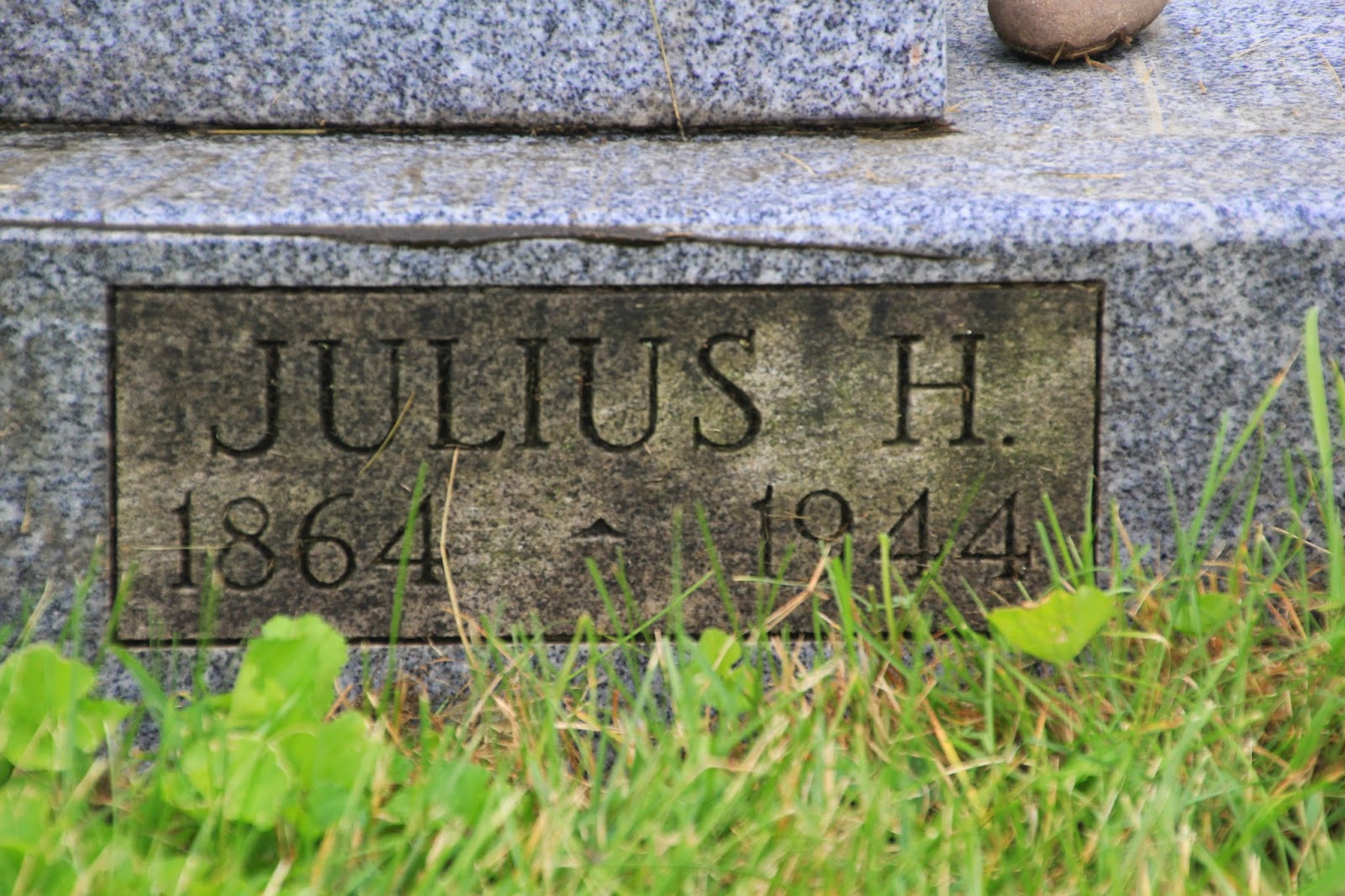
At this Location I found my Great Grandparents, Julius and Ottilie (Herzke) Kroll. Along with their three unmarried daughters. They had a total of Eleven children, some buried here and others scattered across the country.


Someone had visited recently because a smooth  riverstone had been left on the headstone. I left it in place as I took photos and lamented my lack of planning. Fresh flowers would have been a nice touch. The Names of their daughters buried here are pictured below.


After shooting the Kroll Headstone and closeups of the individual names,  I took some broader pictures to help us remember where the grave site is relative to other markers.


We next headed over to the Packhiser's grave site. where I did a quick cleanup and shot some photos, trying to beat the imminent rain. I almost made it, but rain drops splashed down on Ami's grave as I took my final shots.


Again lamenting my lack of planning... I would really have liked to spend a good 30 minutes or so  clearing away the weeds and spiffing up the markers. Fresh flowers would be nice too. Maybe next visit...until then...Rest in PEACE


Thursday, July 10, 2014

Raise your Stein to Charles Packer

A.K.A. Erwin Packhiser circa 1926

Copyright (c )2014 Frederick Walton

When I was a boy, I loved to sit next to my grandfather, Erwin Packhiser, in church. His strong, flawless baritone made the hymns come to life. Rolling his R’s,  he sang with a seriousness and passion that made me wonder why he was not up front with the choir. When I was older, I learned he had already spent a lifetime in the choir and as a singer. A lifetime before grandkids, before children, even before he met my grandmother. By 1926 he had made it to New York's BROADWAY


To me and my siblings he was simply Grossie, that's what we called him. It derived from the German word for grandfather...Grosspapa. To theatre audiences in 1926 he was Charles Packer.  


Recently, while scanning some old photographs of him, I noticed writing on the back. My grandmother had labeled some “Student Prince- 1926”.  To family members these pictures are not new news...I'm sure you have seen them dozens of times over the years. It was also no secret that Grossie sang on Broadway,  so on a whim I googled it. I was amazed to find a a Jan 1926 Playbill cover for The Student Prince at Jolson's 59th Street Theatre. I was even more surprised to find Grossie in it!


source: http://www.playbillvault.com/Show/Detail/6245/The-Student-Prince
Jolson’s 59th Street Theatre opened in 1921 at 932 Seventh Avenue, designed by architect Herbert J. Krapp. The Shubert brothers named their new theatre in honor of Al Jolson, who starred in the opening production Bombo. This would be his first and last appearance at the theatre. 

 Five inside pages where also scanned including, on the third scan, a page listing “Students at Heidelberg”. Among the student I found one “Charles Packer”. This was the professional stage name used by Erwin Packhiser. The "students" formed part of the chorus and performed “The Drinking Song”, “to the Inn We’re Marching”, “Serenade” and “Finale”.

The website can be seen here: http://www.playbillvault.com/Show/Detail/6245/The-Student-Prince
Source: http://www.playbillvault.com/images/whos_who/T/h/The-Student-Prince-01-26-3.jpg

The Operetta is about a  German prince who falls for a waitress while completing his university education in a small town in 1860. I recall seeing the movie version with Mario Lanza and the students seemed to have been spending more time with their beers steins than their books :

             Drink! Drink! Drink!

            Ein zwei drei vier


            Lift your stein and drink your beer


Oddly, Grossie never really talked about this part of his life when I was growing up. There were plenty of reminders, from the concert grand piano in the living room, to trunks of stage clothes and old photos in the attic. I wish now that I asked him to tell me about this part of his life. But it's too late, so my memories of him singing are now often stirred when I stand to sing a hymn in Church...and I hope there are words starting with R in the hymn... so I can try to sing like Grossie! 

Friday, April 18, 2014

Happy Easter Circa 1957

Copyright (C) 2014 Frederick Walton

Middletown, N.Y.-  The developing stamp on the back of the photos below is dated June 1957, however looking at the bare trees and clothing, this obviously wasn’t taken June. In our family, I rarely recall photos being rushed to development anyway. In some cases a roll of film may have lasted half a year or more. Unlike today, people in 1957 generally had a reason to take a picture. Like a holiday , anniversary or birthday. Today the only reason required is being bored... like waiting for the waiter to bring dinner... so they snap a picture of the salt shaker or an unflattering selfie up their nose and post it on Facebook! Gee Thanks!

In 1957 they dressed up for their picture and they looked GREAT! I would guess these photos were taken in the spring , maybe 1957, maybe even earlier. Dee or Jeanne & Fred...do you remember when?

I'm guessing It is most likely Easter (April 21, 1957)...So I send them out to you with Warm EASTER GREETINGS.

Bonus question 1: Whose car is in the background? What was the year and model?
Answer- per Dee: "The car in the background belonged to John McClelland, (Glick), the guy I was dating at the time.  His mother and Ami were friends. "

Bonus Question 2: When did the tree come down and why? All I remember was a giant stump.


Happy Easter, from 1957


Jeanne (24)  and Dianne (16) Packhiser in front of their home at
115 Monhagen Avenue, Middletown, New York , probably April 21, 1957 

Fred Walton (27) and Miss Jeanne (24) Packhiser in front of Jeanne's home at 115 Monhagen Avenue, Middletown, New York , probably April 21, 1957. They would be married a little more than a month later on June 1, 1957 

The Packhiser Family- Dianne (16), Lydia (53), Erwin (59), and Jeanne (24)  Packhiser in front of their home at 115 Monhagen Avenue, Middletown, New York , probably April 21, 1957.
This may be the last "Packhiser" family photo before Jeanne became Mrs. Walton.

Tuesday, April 15, 2014

Ami's Stories: How She Hooked Grossie

Copyright (C) 2014 by Frederick Walton

My grandfather, Erwin Packhiser, had a reputation as an accomplished sportsman. He loved to hunt and fish. His mounted trophies tastefully enhanced the decor of their lovely Monhagen avenue home. Deer heads hung on the wall and colorful, soft feathered, Pheasants were frozen in motion on end tables. I remember a large Snapping turtle shell on the sunporch as well as a couple of large dried up open mouth bass. I don't recall other mounted fish trophies, but I do recall once when I was ten or twelve years old discovering his fishing poles and tackle in the attic. It was like discovering Aladin's treasure. A forbidden treasure too, because we could not touch Grossies things, even though, up to that point in my life, I don't ever recall him using them.
Erwin and Lydia Packhiser In California circa 1932

When I was born in 1958, my Grandfather turned 60. He owned a successful and thriving Dry cleaning business, was active in church and civic organizations and well known around the relatively small town he lived in. He worked long and hard. He wasn't doing much fishing then, but neither was he ready to retire. Whenever I visited, he was long gone before I ever woke up.  His car would pull in and he'd come in the back door ready for breakfast around 8:30 or so, after getting the dry cleaning "plant" up and running.

My grandmother, Ami, would always tell us stories. She was actively involved with the girl scouts and taught nature courses at the girl scout camp. She knew everything about nature, and always had funny stories about why certain leaves were shaped the way they where or why certain flowers bloom when they do. Her sometimes nonsensical stories come back to me even now when I see a aspen leaf quaking in the wind, or see a forget-me-not's bright blue pedals.

One story she used to tell us was about the time when Grossie took her fishing. They were young, and still dating. She had gone along with him even though she had no interest in fishing, but she did have an interest in him. What he caught that day was more than he bargained for. He was casting his line when the hook caught Ami's ear lobe. He took no notice of this since she was some distance behind him and he was looking forward toward the water. As he completed his cast Ami ran forward yelling in pain for him to stop.

 "Irv! Irv! You've hooked my ear!"  she yelled.

He stopped just in time to prevent any serious damage and sheepishly removed the hook. Even in the picture you can see he is a big, goofy, oaf! Although in many other photos he could easily be a handsome leading man.

Anyway, as a result, they fell in love and lived happily ever after...or something like that.

Even as kids, we had our doubts about this story, but she told it to us many times, until we got a little older and more inquisitive.

"Did it Hurt?"

"How did you get it out"

"You're lucky it didn't go into your eye!"

What started as a tale of romance  became on object lesson for us to be careful when we went fishing. Of course growing up on a daily diet go the Three Stooges, it became just the opposite. Whenever we went fishing we would "accidentally" try to hook each other.  We ARE lucky we didn't put an eye out!

I had forgotten about this story and those sunny summer days of fishing along the Wallkill River with my grandfather and my brothers. Recently while scanning some old family photos from Dee I came across the one pictured above. I have lots of fishing photos of Grossie and his catches, but none that back up Ami's story. Look what she wrote on the back:

"Grossie and Ami fishing in Calif.  Grossie was fly casting and his fishhook got caught in my earlobe."

Maybe her stories aren't all fiction. You got to wonder what happened in the woods that day 82 years ago. Did Grossie catch Ami, or did she catch him?


I welcome comments from family members who recall this story or may have something to add. If you already have a Google account you can sign in and add your comments directly.